Quick answer: For a dog in the 100 lb range, you need a harness built with wide, load-bearing straps, steel (not plastic) hardware, and a chest plate that distributes pull force across the sternum instead of the throat. Our top overall pick for 2026 is the Ruffwear Web Master for its handle-and-harness security, with the 2 Hounds Design Freedom No-Pull as the best choice if your big dog pulls hard on leash. Read on for how to measure, what materials actually hold up, and which harness fits your specific situation.
—
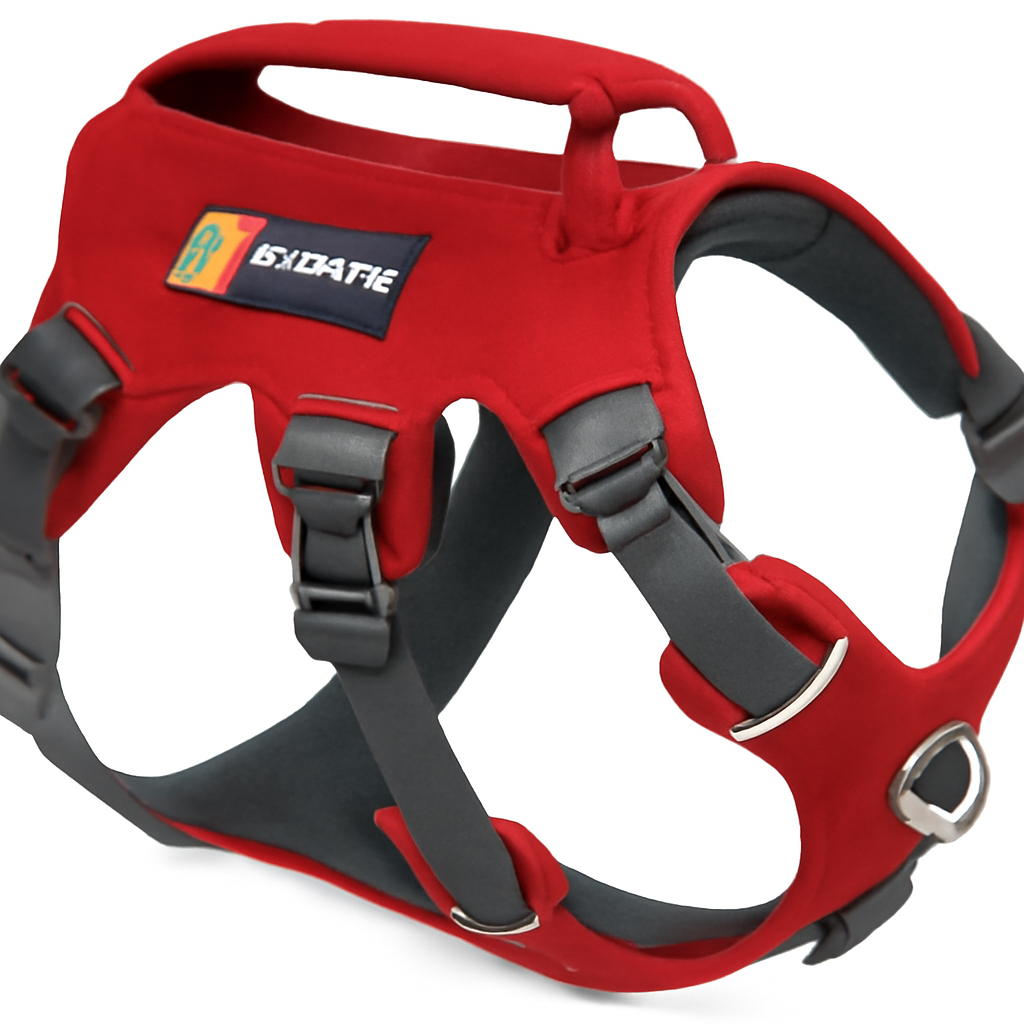
Why Big Dogs Need a Heavy-Duty Harness
A 100 lb dog isn’t just a scaled-up small dog — it’s a different physics problem. When a Rottweiler, Bernese Mountain Dog, Cane Corso, or big Lab lunges after a squirrel, it can generate well over its own bodyweight in sudden force. A cheap harness with a plastic side-release buckle and thin nylon straps will do one of two things: snap at the buckle, or dig a painful line into your dog’s chest and armpits.
There’s also the collar problem. Clipping a leash to a flat collar on a strong dog puts all that force directly on the trachea and neck. For dogs prone to pulling, that’s a recipe for coughing, tracheal damage, and eventually a dog that associates walks with discomfort. A properly built harness moves the load to the chest and shoulders — the parts of a big dog actually designed to carry it.
Finally, there’s you. A harness with a sturdy top handle gives you a control point that a collar never will — for helping an older dog into the car, steadying a reactive dog past a trigger, or hauling 100 lbs out of harm’s way in a hurry.
What to Look for in a 100 lb Dog Harness
Not every “large” harness is actually built for a genuinely large, powerful dog. Here’s what separates a real heavy-duty harness from a big version of a small-dog product.
Load-bearing hardware
This is the single most important spec. Look for welded steel D-rings and metal buckles rather than plastic clips. Plastic side-release buckles are fine for a beagle; on a 100 lb puller they’re the first failure point. If the manufacturer lists an “aluminum” or “steel” V-ring, that’s a good sign.
Wide, padded straps
Force = pressure over area. Wider straps spread the same pull force over more of your dog’s body, so a 1.5″–2″ chest strap is far more comfortable (and safer) than a narrow one. Padding on the chest plate and belly strap prevents chafing on long walks.
Multiple attachment points
The best large-dog harnesses give you both a back clip (for relaxed walking) and a front chest clip (for no-pull steering). Being able to switch — or clip both with a double-ended leash — is a genuine training advantage.
A real handle
For a dog this size, a reinforced top handle isn’t a luxury. It’s how you assist, control, and stabilize.
Adjustability and fit range
Big breeds vary wildly in barrel-chest vs. deep-chest shape. Look for four or more adjustment points so you can dial in girth and neck independently.
Top Picks: Best Harnesses for Large Dogs in 2026
Here’s how our top picks stack up before we get into the detail.
Top Picks at a Glance
| Product | Best For | Price Range |
| Ruffwear Web Master | Overall security + control handle | $$$ |
| 2 Hounds Design Freedom No-Pull | Strong pullers | $$ |
| Kurgo Tru-Fit Enhanced Strength | Car safety + everyday value | $$ |
| Rabbitgoo No-Pull Dog Harness | Budget-friendly all-rounder | $ |
| Ruffwear Front Range | Everyday walking comfort | $$ |
Price ranges are relative tiers, not exact figures — always confirm current pricing.
1. Ruffwear Web Master — Best Overall
The Ruffwear Web Master was originally designed for search-and-rescue and mobility assistance, which tells you everything about its build quality. It uses five points of adjustment, a padded chest and belly panel, and a genuinely reinforced top handle that can bear real weight. For a 100 lb dog, the security of that handle plus the snug, escape-resistant fit is hard to beat.
Pros:
– Extremely secure, escape-resistant fit — great for reactive or anxious big dogs
– Sturdy, load-bearing handle for lifting and control
– Well-padded; comfortable for all-day wear
Cons:
– Back-clip only (not designed as a dedicated no-pull front-clip harness)
– Premium price tier
– Confirm it comes in the largest size range for your dog’s girth
2. 2 Hounds Design Freedom No-Pull — Best for Pullers
If your big dog drags you down the sidewalk, the 2 Hounds Design Freedom No-Pull is the one to look at. It combines a front chest ring with a back ring and a patented martingale-style back loop that gently tightens when the dog pulls, redirecting them sideways instead of choking. The velvet-lined straps reduce armpit chafing, which matters on a barrel-chested breed.
Pros:
– Genuinely effective no-pull steering via front + back attachment
– Velvet strap lining reduces chafing on large chests
– Available in wider strap widths suited to big dogs
Cons:
– No control handle
– Requires correct fitting to work as intended — worth measuring carefully
– Front-clip walking has a learning curve for both of you
3. Kurgo Tru-Fit Enhanced Strength — Best for Car Safety
The Kurgo Tru-Fit Enhanced Strength pulls double duty as a walking harness and a crash-tested car restraint (it includes a seatbelt tether). It uses steel nesting buckles and five adjustment points, making it a strong value pick for owners who drive with their dog regularly.
Pros:
– Steel hardware and crash-tested design
– Includes a seatbelt loop / tether
– Five adjustment points for a dialed-in fit
Cons:
– Bulkier than a dedicated walking harness
– Front-clip no-pull performance is secondary to its car-safety focus
4. Rabbitgoo No-Pull Dog Harness — Best Budget Pick
The Rabbitgoo No-Pull Dog Harness delivers a lot for its price: front and back clips, four adjustment points, a top handle, and padded straps. The hardware isn’t as heavy-duty as the Ruffwear, but for a large dog that’s a moderate rather than extreme puller, it’s a sensible entry point.
5. Ruffwear Front Range — Best Everyday Comfort
The Ruffwear Front Range is the easygoing daily-driver harness: foam-padded chest and belly panels, two attachment points, and four adjustment points. It’s not the most escape-proof option here, but for comfortable everyday walks with a well-mannered big dog, it’s excellent.
No-Pull vs. Standard Harnesses for Strong Dogs
This is the decision that trips up most large-dog owners, so let’s make it simple.
A standard (back-clip) harness attaches the leash between the shoulder blades. It’s comfortable and easy, but for a strong puller it can actually encourage pulling — it triggers the same opposition reflex sled dogs use. Great for a trained dog; frustrating for a puller.
A no-pull (front-clip) harness attaches at the chest. When the dog pulls, the leash turns them back toward you instead of letting them power forward. For a 100 lb dog that hasn’t learned loose-leash walking yet, this is the difference between a walk and a water-ski session.
Our take: If your dog already walks politely, a back-clip harness like the Ruffwear Front Range is more comfortable. If your dog pulls hard, start with a front-clip no-pull option like the 2 Hounds Design Freedom — ideally a dual-clip model so you can transition to back-clip as their manners improve.
How to Measure and Fit a Harness on a Large Dog
A perfect harness fits terribly if you size it wrong — and on a 100 lb dog, a bad fit means either escape or chafing. Here’s the process.
Step 1: Measure girth
Wrap a soft tape measure around the widest part of the ribcage, just behind the front legs. This chest girth is the number that matters most — always size to it, not to your dog’s weight. Two 100 lb dogs can have very different chest circumferences.
Step 2: Measure neck / lower neck
Measure around the base of the neck where a harness neck opening sits (lower than a collar). Some harnesses list this separately.
Step 3: Check the manufacturer’s chart
Ignore breed-name shortcuts and match your measurements to the brand’s own size chart. When you’re between sizes on a deep-chested breed, size up and tighten.
Step 4: The two-finger rule
Once it’s on, you should be able to slide two fingers flat under any strap — snug enough that it won’t twist or slip over the head, loose enough that it doesn’t dig in. Check the armpit area specifically; that’s where chafing starts.
Step 5: Do a movement test
Walk your dog and watch the gait. Straps shouldn’t restrict the shoulders or rub the elbows. Re-check the fit after the first few wears, since padding compresses slightly.
Durability, Materials, and Hardware That Hold Up
For a dog this powerful, materials aren’t a detail — they’re the whole product.
Webbing
Look for heavy-duty nylon or polyester webbing, ideally 1.5″–2″ wide on the load-bearing straps. Double-layered or box-stitched seams (the stitching pattern that forms a reinforced square with an X inside) hold far better under repeated stress than straight stitching.
Hardware
This is where cheap harnesses die. Prioritize:
– Steel or aluminum D-rings, welded closed rather than bent open
– Metal buckles, or at minimum reinforced nesting-style buckles like Kurgo’s
– Rust-resistant coating if your dog swims
The Ruffwear Web Master and Kurgo Tru-Fit both lean on metal hardware, which is why they show up on so many big-dog lists.
Padding and lining
Foam-padded chest plates (Ruffwear) and velvet-lined straps (2 Hounds Design) prevent the friction burns that thin nylon causes on a heavy, active dog. If your dog wears the harness for hours, this matters more than it sounds.
Stitching and stress points
Before every long outing, glance at the seams around the D-ring and the buckle anchors. On a 100 lb dog, those are the points that see peak load, and catching a frayed thread early beats a failure at the worst moment.
Frequently Asked Questions
What size harness does a 100 lb dog need?
Usually Large or X-Large, but never buy on weight alone — measure chest girth and match it to the specific brand’s chart. A deep-chested Great Dane and a stocky Rottweiler can both weigh 100 lbs and wear different sizes.
Are no-pull harnesses safe for large dogs?
Yes, when properly fitted. Front-clip no-pull harnesses like the 2 Hounds Design Freedom redirect force to the chest rather than the throat, which is safer than a collar for a puller. Just avoid overly tight martingale-style tightening and check the armpit fit.
Can I lift my dog with a harness handle?
For brief assistance — into a car, over an obstacle, out of danger — yes, if the harness has a genuinely reinforced load-bearing handle like the Ruffwear Web Master. It’s not meant for prolonged suspension, and the padding should be positioned to support the torso.
Will a big dog chew through a nylon harness?
A determined chewer can damage almost any harness, so don’t leave it on an unsupervised dog. Heavy box-stitched webbing resists casual chewing better than lightweight straps.
Harness or collar for a strong dog?
For walking a 100 lb dog, a harness wins — it protects the trachea and gives you more control. Keep an ID collar on for tags, but attach the leash to the harness.
How often should I replace a heavy-duty harness?
Inspect the hardware and stitching monthly. Replace when you see frayed webbing, a bent or corroded D-ring, or a buckle that no longer clicks firmly. On an active big dog, that’s typically every 1–2 years.
Our Verdict
For most owners of a 100 lb dog, the Ruffwear Web Master is the best all-around choice in 2026 — the combination of an escape-resistant fit, a true load-bearing handle, and quality hardware makes it the safest, most versatile pick for a powerful dog. If your big dog is a determined puller, start instead with the 2 Hounds Design Freedom No-Pull, whose front-clip steering and chafe-free lining are purpose-built for exactly that problem. Drivers who want one harness for walks and the car should look hard at the Kurgo Tru-Fit Enhanced Strength, and budget-conscious buyers get a lot of harness for the money with the Rabbitgoo No-Pull.
Whichever you choose, remember the two rules that matter most for a dog this size: measure the chest girth before you buy, and insist on metal hardware. Get those right, and any of the picks above will keep your big dog secure, comfortable, and under control for years of walks.
Always confirm current pricing and size availability before purchasing — click through to check the latest.