Quick answer: If you want a cat water fountain from Walmart in 2026, the PetSafe Drinkwell Platinum is the safest all-around buy — big capacity, easy to find, replacement filters stocked in-store. If your cat is a chin-acne case or you just hate scrubbing plastic, go PETLIBRO Stainless Steel. Cheap and cheerful? Veken 95oz. Shy drinker who hates pumps? Catit Flower Fountain.
Most cats don’t drink enough water. That’s not a personality quirk — it’s a plumbing problem baked into the species. Cats evolved in deserts and pull most of their moisture from prey. Feed one a bowl of dry kibble and a bowl of still water, and a lot of them will chronically under-drink, which is exactly the pattern vets don’t love when it comes to urinary and kidney health.
Moving water helps. Cats find it more appealing, they drink more of it, and a fountain is a cheap intervention compared to a vet visit for a blocked cat. The question isn’t really whether to get one — it’s which one, and whether Walmart is the right place to buy it.
Why Buy a Cat Water Fountain at Walmart?
Honestly, the fountain market is flooded with near-identical white-label units on Amazon. Same mold, ten different brand names, wildly different quality control. Walmart’s advantage is that they carry a narrower, more curated set — mostly established pet brands that have to survive returns at physical stores.
The practical reasons Walmart wins:
Filters are the real cost. A fountain is a subscription product whether you like it or not. You’ll buy replacement carbon filters every 2–4 weeks for the life of the thing. Walmart stocks PetSafe and Catit filters on the shelf in most Supercenters, which means you’re not stuck waiting on shipping while your cat drinks from stale water. This is the single biggest argument for buying at Walmart over a marketplace seller.
Returns are painless. Cat fountains have a real failure mode: the pump. It’s the only moving part, it lives in water, and it’s the thing that dies. Walmart’s standard return window on pet supplies is generous, and you can walk a dead fountain back into a store instead of arranging a pickup label. Check the current policy at the register — return terms shift.
Store pickup is same-day. Order online, grab it in a couple hours. Nice when your cat’s already showing signs of not drinking enough and you don’t want to wait three days.
You can see the size. Fountain listings are notorious for looking enormous in photos and arriving the size of a coffee mug. Seeing one in the aisle solves that.
The downside: selection is thinner online-only exotic stuff. If you want a hand-thrown ceramic fountain from a boutique brand, Walmart isn’t it. And Walmart Marketplace (third-party sellers on walmart.com) has the same quality-roulette problem as any marketplace — check whether an item is sold and shipped by Walmart itself before you buy.
Top Cat Water Fountains Available at Walmart in 2026
Top Picks at a Glance
| Product | Best For | Price Range |
| PetSafe Drinkwell Platinum | Multi-cat homes, overall best buy | Mid |
| PETLIBRO Stainless Steel Fountain | Chin acne, easy cleaning, hygiene | Mid–High |
| Catit Flower Fountain | Budget pick, picky/shy drinkers | Low |
| Veken 95oz Pet Fountain | Large capacity on a budget | Low–Mid |
| Pioneer Pet Raindrop (Stainless) | Quiet operation, small spaces | Mid |
Availability varies by store and season — check your local Walmart’s stock before driving out.
—
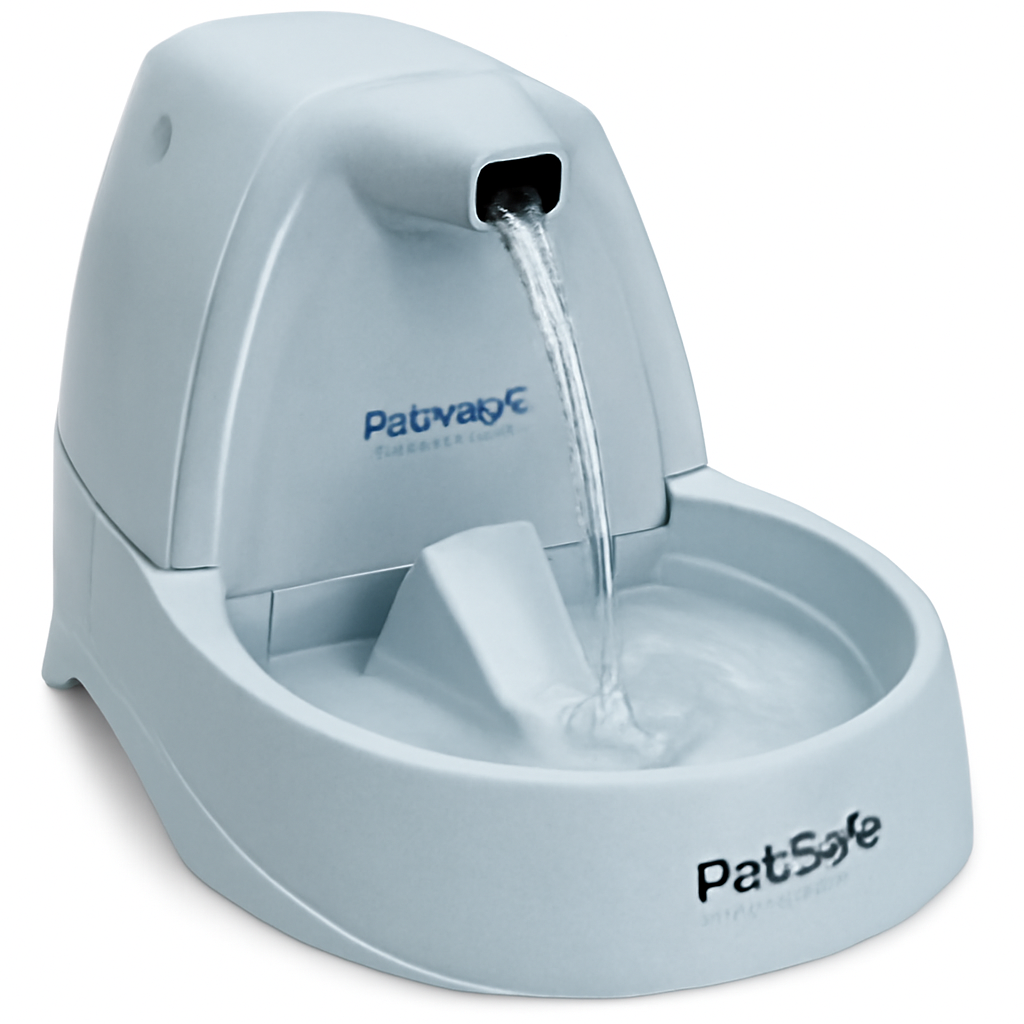
1. PetSafe Drinkwell Platinum — Best Overall
The Drinkwell Platinum is the default answer for most households and has been for years. It’s a large-capacity plastic fountain with a free-falling stream that most cats take to immediately. PetSafe is a legitimate pet brand with actual customer support, and critically, Walmart stocks the replacement filters — both the carbon filters and the foam pre-filters.
The falling-stream design is the key feature. Some cats want a bubbling surface; a lot of cats want something that looks like a faucet. The Platinum gives you the faucet, with an adjustable flow height so you can dial it down if your cat is startled by the splash.
Pros
– Large reservoir — genuinely handles multiple cats or a weekend away
– Adjustable stream height
– Filters and parts widely available at Walmart and online
– Dishwasher-safe components (top rack — verify on your unit’s manual)
– Established brand with real warranty support
Cons
– Plastic. It scratches over time, and scratched plastic harbors biofilm
– More parts to disassemble than the minimalist designs
– The falling stream makes audible splashing — some people find it soothing, some find it maddening at 3am
– Bulkier footprint than most
Buy it if: you have two or more cats, or you want the least-risky purchase with the easiest filter supply chain.
—
2. PETLIBRO Stainless Steel Fountain — Best for Hygiene
PETLIBRO has become the brand to beat in the last few years, and their stainless steel line is the one worth your money. The entire water-contact bowl is steel, which matters more than most people realize.
Here’s why: plastic fountains develop a slimy film — that’s bacterial biofilm — and plastic microscratches give it somewhere to hide. Some cats also develop feline chin acne, a blackhead-like breakout on the chin, and plastic bowls are a commonly cited contributing factor. Switching to steel or ceramic is one of the first things vets suggest. If your cat has a bumpy, dirty-looking chin, this is your fountain.
Steel also just cleans properly. You can scrub it aggressively, run it through a dishwasher, and it comes out actually clean rather than “probably clean.”
Pros
– Stainless steel water surface — resists biofilm, easier to sanitize
– Genuinely quiet pump in most units
– Simple design, few parts, fast to clean
– Often includes a water-level window so you’re not guessing
Cons
– Costs more than plastic equivalents
– Base and some components are still plastic on many models — check the specific SKU
– Steel bowls can’t show you the water level unless there’s a window built in
– Availability at Walmart is more variable than PetSafe
Buy it if: your cat has chin acne, you’re fussy about hygiene, or you’ve owned a plastic fountain and hated the slime.
—
3. Catit Flower Fountain — Best Budget Pick
The Catit Flower is the little plastic one with the flower-shaped top, and it’s genuinely clever despite looking like a gimmick. It offers three flow settings — a gentle bubbling top, a calm surface flow, and multiple small streams — which means you can experiment to find what your specific cat actually likes instead of committing to one style.
It’s small. That’s the tradeoff. One cat, maybe two, and you’ll be refilling every couple of days. But it’s the cheapest legitimate entry point, and Catit filters are common at Walmart.
Pros
– Lowest price of the picks here
– Three flow modes — great for cats with opinions
– Compact footprint
– Widely stocked, filters easy to find
Cons
– Small capacity — not for multi-cat homes
– All plastic
– The flower top has crevices that need real attention when cleaning
Buy it if: one cat, tight budget, or you’re testing whether your cat will use a fountain at all before spending more.
—
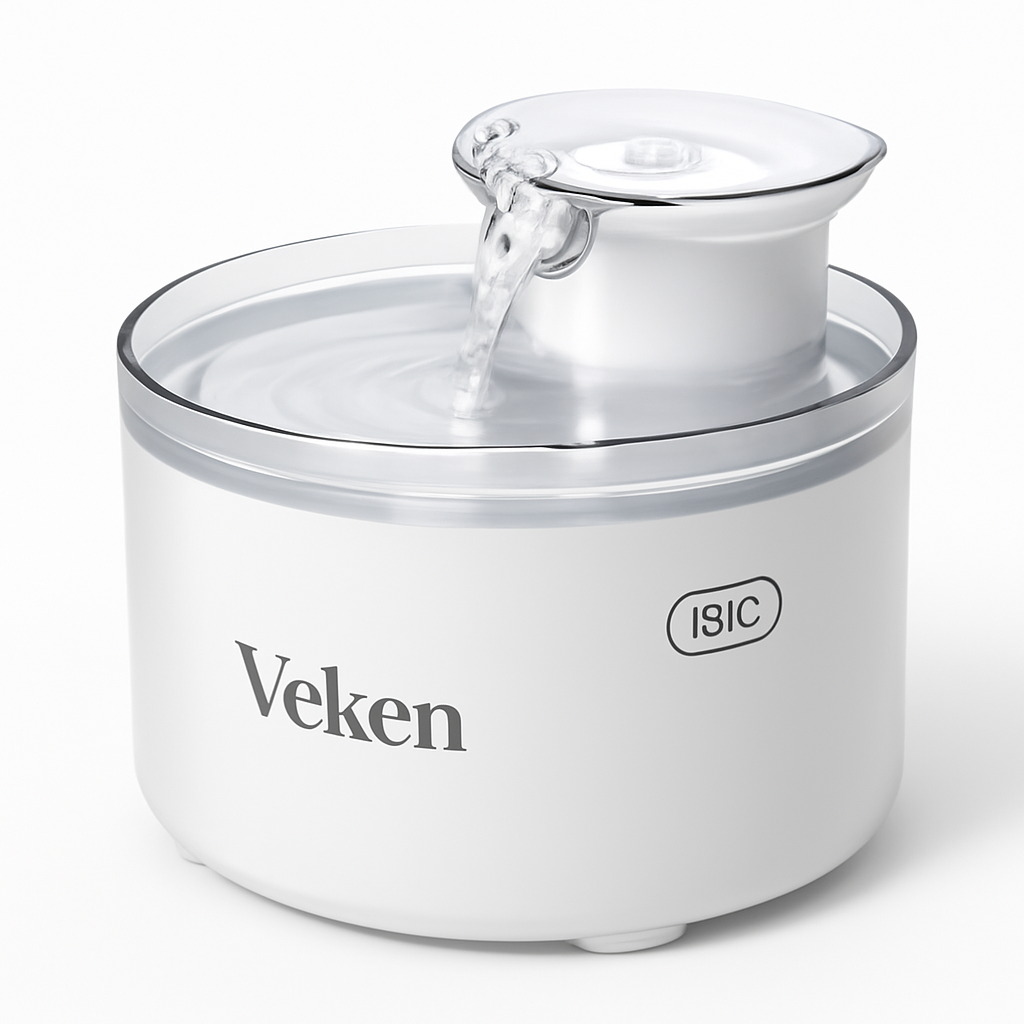
4. Veken 95oz Pet Fountain — Best Capacity Per Dollar
The Veken is the value-capacity play. Large reservoir, low price, and a design that works for cats and small dogs. It’s plastic and it’s not fancy, but you get a lot of water for the money and the pump is reasonably quiet.
Worth knowing: Veken is one of the brands where you should confirm the seller. Buy the version sold and shipped by Walmart, not a marketplace reseller, so returns are clean.
5. Pioneer Pet Raindrop — Quietest Option
Pioneer Pet’s stainless Raindrop is a low-profile, minimal-splash design. Water flows down the face of the unit rather than dropping through air, which cuts noise dramatically. If the fountain lives in a bedroom or a small apartment, this is the one that won’t wake you up. Smaller capacity than the Drinkwell, but the quietest of the group.
Filtered vs. Unfiltered: What Actually Matters
Almost every fountain sold today is filtered, and the marketing wants you to think the filter is purifying the water. It’s mostly not.
What the filter actually does:
The foam/sponge pre-filter catches hair and debris. This is the genuinely important part. Cat hair kills pumps. The pre-filter is what stands between your $30 fountain and a dead motor in six weeks. Clean it weekly, replace it when it stops looking like foam.
The activated carbon layer improves taste and smell. Real, but modest. It pulls chlorine taste out of tap water, which some cats are sensitive to. If your tap water is fine and your cat drinks it happily from a bowl, carbon isn’t transformative.
Some filters add an ion-exchange resin that softens water slightly. Marketed hard, matters little for most cats.
The honest take: the filter’s main job is protecting the pump and keeping water from going stale. It is not a water purifier and it doesn’t replace cleaning. A dirty fountain with a fresh filter is still a dirty fountain.
Do not skip filter changes. A saturated carbon filter can start releasing what it captured. Manufacturer intervals are typically every 2–4 weeks; follow the manual for your unit.
Materials Compared: Plastic, Stainless Steel, and Ceramic
| Material | Hygiene | Durability | Noise | Cost | Notes |
| Plastic | Weakest — scratches, biofilm, chin acne risk | Good, but scratches | Varies | Lowest | Most models; fine if cleaned diligently |
| Stainless Steel | Best — non-porous, sanitizes fully | Excellent | Usually quietest | Mid–High | Best hygiene-per-dollar |
| Ceramic | Excellent if glaze is intact | Fragile — chips and cracks | Very quiet | Highest | Heavy, stable, prettiest |
Plastic is the default and it’s not bad — it’s just the material that demands the most from you. Weekly full teardown cleaning, and replace the unit when the bowl gets visibly scratched.
Stainless steel is the sweet spot. Non-porous, dishwasher-friendly, and it doesn’t degrade. If you’re deciding between a mid-range plastic and a slightly pricier steel model, take the steel.
Ceramic is genuinely great — heavy enough that cats can’t shove it around, beautiful, silent — but a chipped glaze creates a porous spot that traps bacteria, and one countertop drop ends it. Walmart’s ceramic selection is thin. Buy it because you want it in your kitchen, not because it’s meaningfully more hygienic than steel.
Capacity and Pump Noise: Choosing for Multi-Cat Homes
Capacity
The rough rule: budget around 40–50oz of reservoir per cat if you want to refill every few days rather than daily. A 95oz fountain comfortably serves two cats; three or more cats want the largest reservoir you can find, or two fountains in different rooms.
Two fountains in separate locations is underrated anyway. Cats in multi-cat homes guard resources, and a shy cat may simply not approach a fountain a dominant cat has claimed. Splitting them across rooms does more for water intake than upgrading to a bigger single unit.
Pump Noise
Every fountain pump is nearly silent when properly submerged. Nearly all fountain noise complaints trace back to one of three things:
1. Water level too low — the pump sucks air and rattles. This is 80% of noise complaints. Refill it.
2. Air bubble trapped in the pump — lift and tilt the pump underwater to burp it.
3. Debris in the impeller — pull the pump apart and clean the impeller. Do this monthly regardless.
If noise is a real constraint, prioritize designs where water flows down a surface rather than free-falling through air. The Pioneer Pet Raindrop and most stainless PETLIBRO models are quieter than the Drinkwell Platinum’s falling stream for exactly this reason.
Cleaning, Filter Replacement, and Long-Term Costs
This is the part nobody tells you before you buy, so: a cat fountain is a chore. Budget for it honestly.
Weekly: Full disassembly. Dump the water, wash every component with dish soap and a bottle brush, rinse thoroughly, refill. Rinse the foam pre-filter under running water.
Monthly: Pull the pump apart — the impeller cover pops off — and clean the impeller and its housing with a small brush. This one step roughly doubles pump lifespan. A slimy impeller is a dying pump.
Every 2–4 weeks: Replace the carbon filter per the manual.
Every few months: Descale if you have hard water. White vinegar soak, then rinse very thoroughly.
Real Cost of Ownership
| Cost | Frequency | Notes |
| Fountain | Once, every 2–4 years | |
| Carbon filters | Monthly-ish | The recurring cost — check multipacks |
| Replacement pump | Every 1–2 years | Cheap; often sold separately |
| Electricity | Continuous | Negligible — these pumps draw very little |
The filters are where the money goes. Before you commit to a brand, look up its filter multipack price at Walmart and multiply by 12. That number, not the sticker price, is what you’re signing up for. It’s also the reason to favor PetSafe and Catit — their filters are common, competitively priced, and stocked in-store.
Walmart Price Ranges, Store Pickup, and Return Policy
Price tiers you’ll typically see in the cat fountain aisle:
– Budget: Small plastic fountains, Catit Flower territory —
– Mid-range: Large plastic (Drinkwell Platinum, Veken) and entry stainless —
– Premium: Full stainless and ceramic, larger PETLIBRO models —
Store pickup: Order on walmart.com or the app, select pickup, and it’s usually ready the same day for in-stock items. Faster than any shipping option and you skip porch-theft risk.
Returns: Walmart’s general policy on pet supplies is a standard return window with receipt, and in-store returns work for items bought online. Two caveats — Marketplace items sold by third parties may follow different terms, and a used fountain’s returnability can be at the store’s discretion. Keep the box for the first few weeks. Confirm current policy at walmart.com/returns before buying, since terms change.
Watch the seller field. On walmart.com, check for “Sold and shipped by Walmart.” That’s your clean-return, real-inventory version. Marketplace listings are the ones where a Veken or PETLIBRO might arrive from a reseller with different support.
Frequently Asked Questions
Do cats actually drink more from a fountain?
Most do. Moving water is more attractive to cats, and it stays fresher and cooler than a standing bowl. It’s not universal — some cats ignore fountains entirely — but it’s a low-cost, high-upside change, especially for a dry-food cat.
How often should I change the water even with a filter?
Fully change it weekly at minimum, at the same time you do the full clean. Top it off between changes. Filters don’t make water last indefinitely.
Is stainless steel worth the extra money over plastic?
Yes, for most people. Easier to clean, doesn’t scratch into a biofilm trap, and eliminates the plastic-chin-acne variable. If you know you’re not going to be diligent about weekly scrubbing, steel is even more worth it.
My cat is scared of the fountain. What do I do?
Keep the old water bowl out. Run the fountain on its lowest flow setting nearby for several days so the sound becomes normal. Don’t remove the bowl until you’ve actually seen the cat drink from the fountain — cutting off the familiar option can cause a cat to just drink less.
Can I run it without a filter?
Technically, but don’t. At minimum keep the foam pre-filter in — that’s what protects the pump from hair.
Why is my fountain making noise?
Almost always low water. Refill it above the pump’s minimum line. If that doesn’t fix it, burp the air out of the pump underwater, then clean the impeller.
Do I leave it running 24/7?
Yes. These pumps are designed for continuous operation and draw very little power. Turning it off lets water go stagnant, which defeats the purpose.
Is it safe to put in the dishwasher?
The bowl and lid on most units, top rack — but never the pump. Check your manual; some plastic parts warp.
Our Verdict
For most people, buy the PetSafe Drinkwell Platinum. It’s the lowest-risk purchase in the category: proven design, capacity that handles multiple cats, adjustable flow to suit a picky drinker, and — the part that actually matters long-term — filters you can grab off a Walmart shelf on a Tuesday instead of ordering and waiting. Its weakness is that it’s plastic and the falling stream is audible.
If you can spend a bit more, get the PETLIBRO Stainless Steel instead. Steel is the single best upgrade in this category. It cleans properly, it doesn’t develop scratched-plastic slime, and it takes chin acne off the table. Quieter, too. This is what I’d buy for my own cat.
On a tight budget, the Catit Flower Fountain is a legitimate product, not a compromise — the three flow modes make it genuinely good at winning over a cat who’s suspicious of fountains. Just know it’s a one-cat unit.
Need volume cheaply? The Veken 95oz gives you the most water per dollar. Need silence? The Pioneer Pet Raindrop is the bedroom-safe pick.
Whichever you pick, the fountain matters less than the maintenance. A cheap fountain cleaned weekly beats a premium one running on three-week-old water every single time. Buy the one you’ll actually keep clean, put it somewhere away from the litter box and the food bowl, and keep a spare pack of filters in the cupboard.