Training a stubborn dog — or one that bolts the second the gate opens — can feel impossible when off-leash commands just don’t stick. A remote training collar is one of the most effective tools for reliable recall and boundary training, but the market is flooded with cheap, poorly built units that either don’t work or aren’t safe. The good news: you don’t need to spend $200+ to get a dependable collar. There are genuinely solid options under $100.
Quick answer: For most dog owners on a budget, the PetSafe Remote Trainer offers the best mix of reliability, safety, and value under $100. If you have a large or hard-headed dog and need more range, the SportDOG SportTrainer 575 is worth stretching for. For small dogs, the Bousnic Dog Training Collar is a strong pick.
Below, we break down what actually matters, review the top budget picks, and walk you through introducing a collar safely and humanely.
—
Why Trust Our Dog Shock Collar Picks
We approach training collars the same way a professional trainer does: as a communication tool, not a punishment device. Every recommendation here is filtered through three questions:
1. Is it safe? Does it have adjustable stimulation levels, a tone/vibration-only option, and a safety lockout to prevent accidental over-correction?
2. Is it reliable? Does the signal actually reach the dog at the advertised range, and does the battery hold up?
3. Is it worth the money? Under $100, corners get cut somewhere — we look for the units that cut the right corners (fewer accessories) instead of the wrong ones (weak build, laggy response).
We prioritize collars with a wide range of low-level static levels, because good training relies on finding the lowest setting your dog notices — not the highest. We do not recommend any collar that only offers a single, fixed shock intensity, and we don’t cite invented ratings or review counts. Where a price would go, you’ll see so you can confirm the current, accurate cost yourself.
—
What to Look for in a Budget Shock Collar Under $100
Spending less doesn’t mean you have to compromise on the features that matter. Here’s your checklist.
Adjustable Stimulation Levels
Look for at least 1–100 levels of static adjustment, or a comparable stepped range. More granularity means you can dial in the lowest effective setting for your specific dog. Collars with only a handful of jumps often skip right past your dog’s threshold.
Multiple Modes (Tone, Vibration, Static)
A three-mode collar (tone, vibration, static) gives you a training ladder. Many dogs respond to tone or vibration alone once conditioned, meaning you rarely — if ever — need static.
Safety Lockout / Keypad Lock
A physical lock button prevents you from bumping the intensity dial in your pocket. This is a genuine safety feature, not a gimmick.
Waterproof Receiver
Dogs get wet. A waterproof (ideally IPX7-rated) receiver survives rain, puddles, and swims. Splash-proof-only units die fast.
Rechargeable Batteries
Rechargeable remote and collar with USB charging is now standard even at this price. Skip anything requiring proprietary or disposable batteries.
Range That Matches Your Use
Backyard training needs far less range than field or trail recall. Don’t overpay for 1-mile range you’ll never use — but don’t buy 100 yards if you hike open land.
—
Top Dog Shock Collars Under $100 Reviewed
Top Picks at a Glance
| Product | Best For | Price Range |
| PetSafe Remote Trainer | Most owners / best overall value | Under $100 |
| SportDOG SportTrainer 575 | Large or stubborn dogs, longer range | Under $100 (higher end) |
| Bousnic Dog Training Collar | Small dogs & multi-dog homes | Budget |
| PATPET Dog Training Collar | First-time users on a tight budget | Budget |
| Petrainer PET998DRB | Two-dog training on one remote | Budget |
—
1. PetSafe Remote Trainer — Best Overall Value
PetSafe is one of the most established names in dog training gear, and their budget remote trainers hit the sweet spot of trustworthiness and price. You get a solid range of static levels plus tone and vibration, a durable waterproof receiver, and a brand with real customer support behind it — something no-name Amazon brands rarely offer.
It’s not the flashiest unit, but it’s the one we’d hand to a first-time owner without hesitation.
Pros:
– Reputable brand with responsive customer service and warranty
– Waterproof receiver holds up to rain and swims
– Simple, intuitive remote — easy to learn under stress
– Reliable signal at typical backyard-to-park distances
Cons:
– Shorter range than field-focused competitors
– Fewer fine-grained static steps than some budget rivals
– Styling and accessories are basic
—
2. SportDOG SportTrainer 575 — Best for Large or Stubborn Dogs
If your dog is big, thick-coated, or simply ignores lower-end collars, the SportDOG SportTrainer line is built for you. SportDOG is a favorite among hunting and working-dog owners, and even their entry models feel a notch more rugged than typical budget units. Expect longer usable range, a bright display, and stimulation that’s strong enough to get through to a determined dog — while still offering low levels for gentle work.
At the top of the under-$100 bracket, but you’re paying for build quality that lasts years.
Pros:
– Longer, more reliable range for open areas and trails
– Rugged, genuinely waterproof (submersible) construction
– Wide static range plus tone and vibration
– Fast, “gloved-hand-friendly” button layout
Cons:
– Near the top of the $100 budget
– Bulkier receiver — overkill for toy breeds
– More features than a casual backyard trainer needs
—
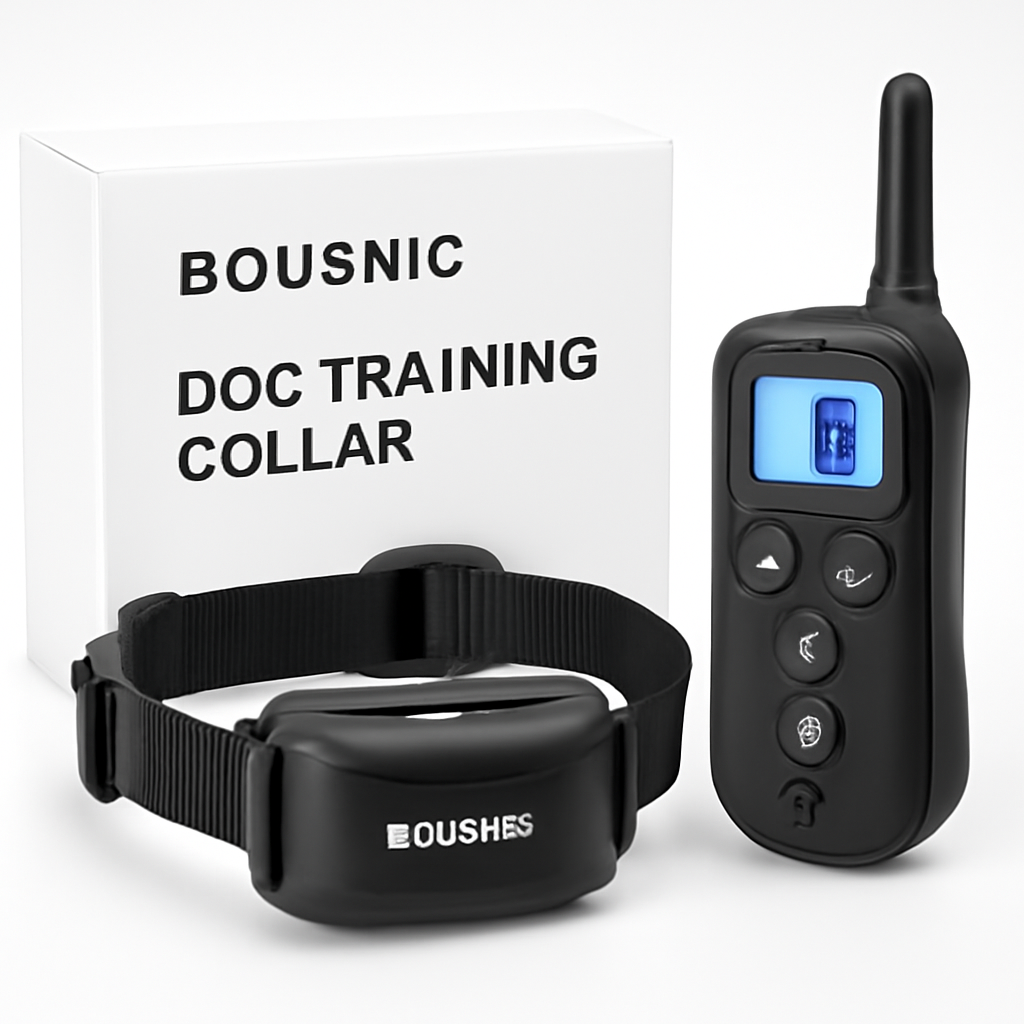
3. Bousnic Dog Training Collar — Best for Small Dogs & Multi-Dog Homes
Bousnic has become a popular budget choice for a reason: a wide 0–99 static range, three modes, a security keypad lock, and a rechargeable design — all at a price that undercuts the big names. Many versions support two collars on one remote, making it a smart pick if you’re training more than one dog.
The keypad lock and low starting levels make it surprisingly gentle-capable for smaller breeds.
Pros:
– Fine-grained static adjustment (0–99) for dialing in low levels
– Keypad security lock prevents accidental corrections
– Often supports two dogs on one remote
– Very affordable
Cons:
– Support and long-term durability don’t match premium brands
– Range claims can be optimistic in real-world obstacles
– Fit can be loose on very small necks without adjustment
—
4. PATPET Dog Training Collar — Best Budget First Collar
PATPET keeps things simple and cheap without feeling disposable. You get tone, vibration, and static modes, a lightweight waterproof receiver, and an easy-to-read remote — a good entry point if you’re testing whether e-collar training is right for you before investing more.
Straightforward, lightweight, and beginner-friendly.
—
5. Petrainer PET998DRB — Best Two-Dog Budget Option
A long-running budget staple, the Petrainer PET998DRB pairs one remote with support for two collars and includes tone, vibration, and static. It’s basic and the ergonomics are dated, but for multi-dog households counting every dollar, it’s hard to beat on price.
—
Static vs. Vibration vs. Tone: Understanding the Modes
The word “shock” scares a lot of owners — and it should make you thoughtful. But modern training collars are really multi-signal communication tools. Here’s how the three modes work and when to use each.
Tone
A beep. Most dogs learn to associate it with a command (“that’s the marker to come back”). It’s the gentlest cue and often the one you’ll use most after initial conditioning. Great as a recall signal or a “pay attention” prompt.
Vibration
A buzz on the neck, similar to a phone in your pocket. More noticeable than tone, still no static involved. Vibration is excellent for dogs who tune out sound, and it’s the go-to mode for deaf or hard-of-hearing dogs.
Static
A mild electrical stimulation. On a quality collar with a wide level range, the lowest effective setting is often something the dog can barely perceive — a tap, not a jolt. Used correctly, static is a brief, consistent interruption, not a punishment. The goal is always the lowest level that gets a response.
The right approach: Condition tone and vibration first. Reserve static for situations where safety matters most (bolting toward a road, chasing wildlife) and always at the minimum effective level.
—
Range, Battery Life, and Waterproofing Explained
Range
Advertised range is measured in ideal, open-line-of-sight conditions. Walls, trees, hills, and even your own body between remote and collar cut it down significantly. Match range to reality:
– Backyard / house: 100–300 yards is plenty
– Parks and neighborhood: 400–800 yards
– Trails, fields, hunting: 800 yards to a mile+
Don’t overbuy. Beyond your line of sight, you often can’t see what your dog is doing anyway.
Battery Life
Most modern budget collars use rechargeable lithium batteries in both remote and receiver, charging via USB. Expect several days to a couple of weeks per charge depending on use. Look for a low-battery indicator so you’re never caught mid-session. Quick-charge features are a nice bonus for owners who train daily.
Waterproofing
Focus on the receiver (the collar unit) — that’s the part your dog wears through rain and water. An IPX7 rating means it survives submersion; anything labeled only “splash resistant” will likely fail over time. Remotes are usually less protected, so keep yours out of the rain.
—
How to Safely Introduce a Shock Collar to Your Dog
A training collar is only as humane and effective as the person using it. Rushing this process is the most common mistake. Follow these steps.
1. Fit It Correctly
The collar should be snug enough that the contact points touch the skin, but you can still slip a finger underneath. Too loose = inconsistent signal and skin irritation from rubbing. Check placement and rotate collar position during long sessions.
2. Let Your Dog Wear It (Off) First
Have your dog wear the collar with no stimulation for a few days during normal play and meals. This prevents them from associating the collar itself with corrections — you don’t want a “collar-wise” dog who only behaves when it’s on.
3. Find the Recognition Level
With the dog calm, start at the lowest static level and increase one step at a time until you see a mild acknowledgment — an ear flick, a head turn, a slight glance. That’s the recognition level. It should be subtle, not a yelp or flinch. This is your working level; you’ll rarely go above it.
4. Pair Signals With Known Commands
Introduce the collar with commands your dog already knows (like “come”). Give the command, use tone or a low static tap as reinforcement, then reward heavily when they respond. You’re building association, not fear.
5. Keep Sessions Short and Positive
Ten to fifteen minutes, always ending on a win. Consistency beats intensity every time.
6. Know When to Get Help
If your dog shows fear, anxiety, or aggression, stop and consult a professional trainer. Certain issues — especially fear-based or aggressive behavior — should never be addressed with static correction alone.
—
Frequently Asked Questions
Are shock collars safe for dogs?
When used correctly — with adjustable levels, at the lowest effective setting, and paired with positive reinforcement — quality training collars are considered safe by many trainers. Misuse, high levels, or using them on fearful dogs is where harm happens. The tool isn’t the problem; technique is.
What’s the lowest my dog’s weight should be for a shock collar?
Most manufacturers set a minimum around 8–10 lbs. For small breeds, choose a collar with a lightweight receiver and very low starting static levels, like the Bousnic or a small-dog-specific PetSafe model.
Can I use a training collar on a puppy?
Generally, wait until at least 6 months and until basic obedience is established with positive methods first. Very young puppies aren’t developmentally ready for this kind of correction.
Do I have to use the static/shock mode?
No. Many owners train successfully using only tone and vibration after initial conditioning. A three-mode collar gives you that flexibility.
How much should I expect to spend?
Solid, safe collars start well under $100. Paying more usually buys longer range and rugged build — not necessarily better training results for the average pet owner. Always confirm current pricing at before buying.
Are cheap no-name collars worth it?
Some budget brands like Bousnic and PATPET offer real value. The risk with truly generic units is inconsistent signal, poor waterproofing, and no support if something fails. Stick to brands with a track record.
—
Our Verdict
You don’t need to overspend to train your dog effectively and humanely. For the majority of owners, the PetSafe Remote Trainer is the best overall pick under $100 — trustworthy, safe, waterproof, and backed by a real company. If you’ve got a large, thick-coated, or especially stubborn dog, step up to the SportDOG SportTrainer 575 for the extra range and rugged build. Training more than one dog or working with a smaller breed on a tight budget? The Bousnic Dog Training Collar delivers impressive features for the price, and the PATPET and Petrainer PET998DRB round out the budget field nicely.
Whichever you choose, remember: the collar is a communication tool. Start low, condition with tone and vibration, reward generously, and use static sparingly at the lowest effective level. Do that, and even a budget collar can transform your dog’s off-leash reliability.
Always confirm current pricing and product specifications before purchasing.